Artificial intelligence (AI) is a present-day imperative. From automating routine tasks to generating profound customer insights, AI promises a revolution in efficiency, innovation, and competitive edge, especially in an era of rapid market shifts. Yet, many businesses discover that the hardest part of an organizational transformation is the people.
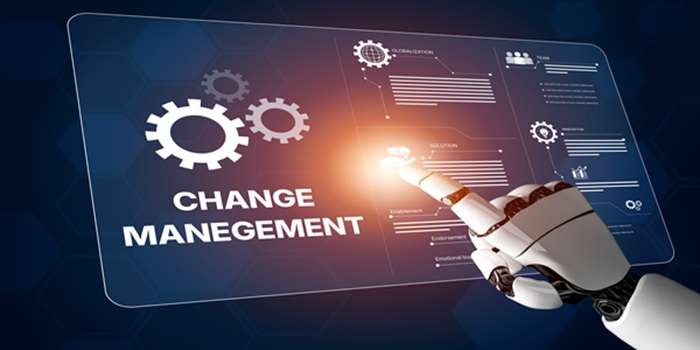
A brilliant machine learning algorithm is useless if the team doesn’t trust it, understand it, or know how to use it. The true key to unlocking AI’s transformative potential lies not in the code, but in the strategy that guides its adoption. This is where a robust and deliberate change management process becomes the most critical asset for building an AI-empowered organization.
Why AI Initiatives Fail Without a Human-Centric Approach
It’s a common story: a company invests heavily in a state-of-the-art AI platform, only to see it languish. Employees revert to old workflows, managers bypass the new insights, and the projected ROI never materializes. Why does this happen?
The failure is rarely technical. It’s cultural. Common human-centric hurdles include:
- Fear and job security: Employees often fear that AI will automate their roles into obsolescence.
- Lack of understanding: Without clear communication, AI can seem like an incomprehensible “black box,” leading to mistrust.
- Insufficient training: Being handed a powerful new tool without proper guidance is a recipe for frustration and abandonment.
- Cultural inertia: “This is the way we’ve always done it” is a powerful force that can stall any innovation.
Ignoring these human factors is the fastest way to derail an AI investment. A purely technical implementation creates resistance, while a strategic focus on the human element paves the way for smooth adoption. Organizations can bridge this gap with a dedicated approach designed to empower your organization to adapt and thrive with AI change management solutions. Experts can guide you through the entire transformation process to ensure your team is equipped, informed, and confident when adopting AI tools and workflows.

A Framework for Successful AI Adoption and Digital Upskilling
Effective AI change management is the disciplined framework that prepares, equips, and supports individuals to successfully adopt AI, driving organizational results. Here’s a practical framework to guide the journey:
1. Lead with a clear vision
Before any code is written, leadership must articulate a compelling vision. What business problem is AI solving? How will it make employees’ work more meaningful by eliminating drudgery? This “why” must be communicated relentlessly and connected to each team’s daily reality, showing how AI augments their capabilities rather than replaces them.
2. Foster widespread AI literacy
Host workshops, lunch-and-learns, and create simple resources that explain what AI is and, just as importantly, what it isn’t. For instance, differentiate between machine learning that identifies patterns in real-time data and generative AI that creates new content. When employees understand the basics, fear is replaced by curiosity and engagement, laying the foundation for true employee engagement.
3. Involve employees early
Involve end-users from the very beginning. Form a pilot group of champions from different departments to act as change agents. Their frontline feedback is invaluable for refining the tools, and their buy-in turns them into powerful advocates for the wider rollout, positively influencing the overall company culture.
4. Invest in role-specific training and AI governance
Provide hands-on, role-specific digital upskilling that shows each employee exactly how the new AI tool will integrate into their specific workflows. For example, a marketing team needs training on generative AI for content creation, while a finance team needs to understand predictive analytics for forecasting.
A critical component of this training is AI governance, which includes ethical guidelines and a clear framework for responsible use. Furthermore, specialized training, such as from a prompt trainer, can teach employees how to effectively communicate with AI systems to get the best results.
5. Cultivate a culture of experimentation and psychological safety
Encourage employees to try new AI tools. Celebrate learning, even from mistakes. When people feel safe to try and fail, they are more likely to discover innovative uses for AI that were never anticipated by the initial implementation team. This agile approach is key to leveraging real-time data and adapting to new opportunities.
The Bottom Line
Investing in AI technology without investing in people is a high-risk strategy. The transformative power of AI is its ability to augment human potential. The goal shifts from simply implementing a new system to building a more agile, innovative, and future-ready AI-empowered organization. The businesses that will lead in the age of AI won’t be the ones with the most powerful algorithms, but the ones with the most adaptable, empowered, and engaged people.
Read More: Unlocking Success with the Right E Commerce Models